

Table of Contents
Coffee, Gadget, Both or Nothing
When my kids were younger, we used to sit in the lobby of our building waiting for their mom to come home from work. To pass the time, we played a game we affectionately called Coffee, Gadget, Both, or Nothing. The rules were simple: if someone walked by carrying a drink, they were a “Coffee.” If they held a piece of tech, they were a “Gadget.” If they had both, you guessed it – “Both.” And if they had neither, they were a “Nothing.”
Times have changed. Back then, the “Nothing” category was common. People simply walked, talked, or strolled empty-handed. There wasn’t portable technology and the proliferation of on-the-go beverages hadn’t gripped us yet. Today, spotting a true “Nothing” feels like finding a rare bird. Busy hands, busy lives, I guess. It says something about how we show up in the world – and how much (or how little) we notice.
That game became an early lesson in paying attention. It wasn’t about being right or wrong; it was about seeing the world in a playful way. And isn’t that what listening really is? Noticing. Attending. Catching things you might otherwise miss.
In my life and in my coaching, I’ve discovered there are many ways to listen. Here are seven that continue to surprise me with the joy, connection, and clarity they bring.
For Fun: Download the Coffee, Gadget, Both or Nothing Score Sheet.
7 Ways to Listen (Graphic)
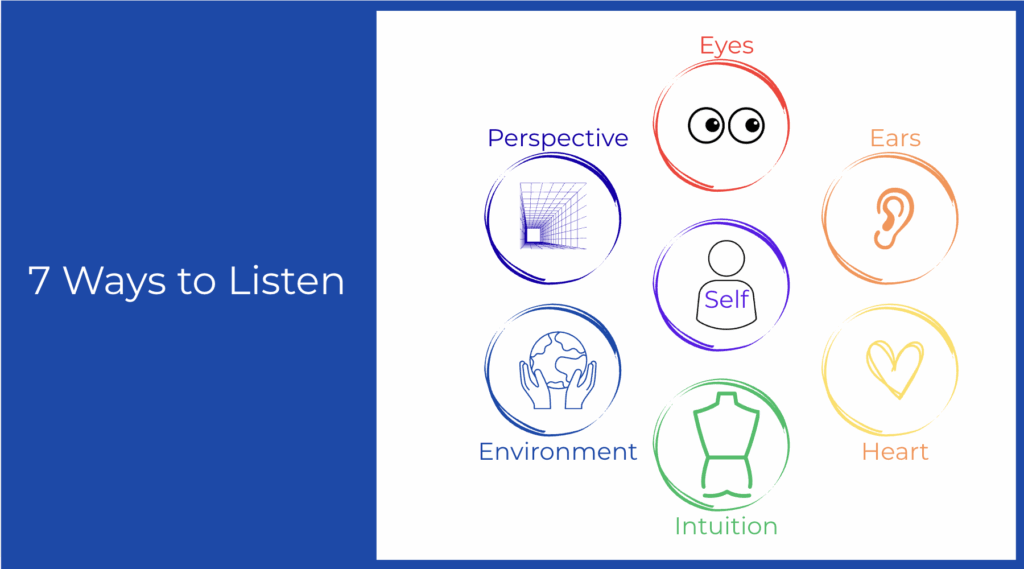
1. Listening with Your Ears (But Go Deeper)
We often think of listening as a purely auditory skill – just hearing words. But the truth is, it’s so much more than that.
A few months ago, I was at the car service center. I’d already been waiting three hours when the service rep asked me to watch a video from the technician. I waved it off – I just wanted to get out of there. Later, I learned I’d ignored an important note about my tires. My unwillingness to listen carefully ended up costing me an extra couple of hundred dollars and another wasted hour.
That day, impatience won. I heard the request but didn’t really listen.
If I had listened with more than my ears, more than just registering the words and the request, I could have saved myself time, money, and frustration. Really listening in this situation would have enabled me to hear the tone, catch the hesitation, notice the pause before the service rep said “OK” and what that meant for me.
2. Listening with Your Eyes
Words are only a fraction of the story. What we see can sometimes reveal more than what we hear.
I was at a party on Long Island last year. Driving home, a friend and I compared notes. I had been tuned in to stories: vacations, work struggles, kids’ updates. My friend hadn’t caught any of that. Instead, they described what everyone wore – the jewelry, tattoos, outfits, and what they meant.
I listened dumbfounded for 10 minutes. Were we at the same party? Did we talk to the same people? What else didn’t I see (or notice or listen for)? This person had processed the complete physical environment.
My wife then chimed in, not about stories or fashion, but about relationships: who lit up around whom, who kept their distance, who pulled attention.
We had been at the same event, but we’d listened through entirely different lenses. Their eyes caught what my ears missed.
Research backs this up: experts estimate that 70–90% of communication is non-verbal. Facial expressions, gestures, posture – these speak volumes.
3. Listening with Your Heart
Sometimes listening means noticing emotion, not just information.
At a trivia night with friends, one of my son’s friends mentioned they’d just come over from college to join. It wasn’t what he said – it was how he said it. There was an energy in his voice – he was so excited. So, I asked, “What’s going on at school?” His face lit up, and for the next fifteen minutes, he spoke with joy about science, experiments, and the possibility of changing the world.
Had I not tuned in to that enthusiasm, I would have missed a conversation that left me fascinated and inspired.
When I listened with my heart, I was attuned to the excitement. It could just as easily have been disappointment, joy, grief, or pride. I’m trying to listen for the undercurrent beneath the words.
4. Listening with Your Gut
Sometimes your body knows what your ears and eyes don’t catch. That gut feeling – the quiet nudge that something is off, or right – counts as listening too.
Think about a time you walked into a room and immediately felt tension, even before anyone spoke (aka “reading the room”). Or when you met someone and instinctively felt at ease. That’s your gut listening.
Coaches often call this intuition. It’s the felt sense that guides you before logic kicks in. Knowing without processing in the rational mind. Neuroscience shows that the body carries “somatic markers” that influence decision-making. In plain terms: your gut keeps score.
In my experience, some people might be hesitant to tap into their intuition (or emotions), preferring to rely on logic alone. Let me suggest that intuition is another data point, another way of generating information – and if you can listen to it, check in with it, and then decide what to do, you’ll make a richer, more informed decision. Listening doesn’t necessarily mean agreeing or accepting.
5. Listening to the Environment
Listening doesn’t have to be about people at all. It can be about tuning into the world around you.
When I jog through Central Park, I leave the headphones at home. I move slowly these days, but that pace lets me notice. My breath. The laughter of kids. A drummer at the South end of The Mall. The smell of flowers. Fireflies glowing in the meadows at dusk. It’s a lot to take in and it’s easy to miss these if I’m distracted by music jacked into my ears. But when I listen (with all of my senses), the city feels alive.
Nature teaches us that silence isn’t empty. Silence is full of subtle cues – wind in the trees, birds calling, footsteps approaching, and sometimes the breeze of a speeding bicycle just as I’m about to jog across a busy intersection.
6. Listening Across Perspectives
I miss a lot, too. What one person hears, another sees, and a third feels. Sharing perspectives is a form of listening.
That party conversation with my wife and friend reminded me of this. My story was linear, focused on words and details. My friend’s lens was physical, noticing appearances. My wife’s lens was relational, mapping dynamics. None of us was wrong. Together, we created a fuller picture.
Sometimes my wife hears me talking on the phone and sharing an experience we had together, going to the beach, seeing a movie, visiting a friend – whatever it may be. And when I get off the phone, she turns to me and says “So, that’s what happened”? When we compare “notes”, we illuminate what the other missed.
In Chris Voss’s book, Never Split the Difference, he talks about listening during hostage negotiations. “Nobody worked alone. We always worked in teams. The thinking behind this policy was that all these extra sets of ears would pick up extra information…One of us was trying to gauge the mood of the bad guy taking the lead on the other end, and another was listening in for clues or ‘tells’ that might give us a better read on what we were facing.”
Multiple sets of ears caught more than anyone could alone. Same same.
Everybody processes the world in their own way, through their own set of lenses. I’m trying to grow my set of lenses, noticing different things. Listening in different ways. It requires me to be present. To shift my focus and awareness. To zoom in and to zoom out.
I’ve found that it’s great to process the same shared experiences with others, because each person brings their own set of lenses and tells a different story. There is so much to learn from others.
7. Listening to Yourself
Another form of listening is inward. Noticing your own thoughts, feelings, and intuition.
In coaching, I often invite people to pause and ask, “What’s here right now?” Sometimes the answer is clarity about a value, an emotion that needs naming, or a hidden desire. Listening inward brings you closer to your self – mind, emotion, body, spirit, urges, and beliefs.
This kind of listening doesn’t require hours of meditation. Even a short pause can reveal a lot. Maybe your body says, “I’m exhausted,” or your heart says, “I’m excited,” or your mind says, “I’ve been ignoring this idea too long.”
Listening Practice Exercises
Here are a few ways to put these different ways to listen into practice. Try one, try several, try them all – they’re free, they’re fun, and once you experience it, it can be like having a new superpower.
Listening …
- With Your Ears: Next time someone speaks, don’t just catch the words – listen for tone, pauses, and emphasis. What are they saying between the lines?
- With Your Eyes: In your next conversation, pay attention to body language, facial expressions, or what changes when someone new walks into the room.
- With Your Heart: Notice the moments when someone’s energy shifts. Ask a curious question. Listening with your heart often opens doors to deeper connection.
- With Your Gut: The next time you face a decision or meet someone new, pause and notice what your body tells you. Do you feel open, tense, light, or heavy? Listening to your gut can guide your choices.
- To The Environment: Go for a short walk without your phone or music. Notice the sounds, scents, and sights around you. What details stand out?
- Across Perspectives: After a shared experience – a family trip, a work meeting, a concert – compare notes. Ask, “What stood out to you?” You’ll be amazed at what you missed. (Power move: before the event, assign each person a ‘way to listen’ and see how much they pick up through that lens).
- To Yourself: Take five quiet minutes today. Breathe. Notice what your inner voice says when you give it space. Your thoughts, your intuition, your emotions, your body. Write it down if it helps.
There are so many opportunities to try this out – even the next conversation – whether it’s a virtual meeting, face-to-face, or even just over the phone. Personal- or work-related. Or even when you read an email or text message from someone – read the words and then try to notice the underlying intent, emotion, unstated things. See what you notice and discover.
Bringing It Back: Coffee, Gadget, Both or Nothing
These seven ways of listening aren’t rules – they’re invitations. Invitations to notice more. To be present. To catch the enthusiasm in a friend’s voice, the shift in a colleague’s posture, or the joy in your own heart.
Sometimes, I still play Coffee, Gadget, Both or Nothing as I walk down the street. It reminds me that listening doesn’t have to be serious. It can be playful, curious, reminiscent and joyful.
Because listening isn’t just about hearing – it’s about being awake to the world.
Conclusion
Listening opens doors we didn’t know were there, because now we can see the doors, we notice them. It helps us connect more deeply with others, with ourselves, and with the world around us. It makes life richer, more joyful, and more meaningful.
So here’s a gentle challenge: in your next conversation or walk or meeting, pick one of these seven ways to practice. Notice what opens up.
And if you’re curious about how listening can transform not just moments, but your whole way of living and leading, I’d love to explore that with you in coaching.
Further Reading & References
- Co-Active Levels of Listening: https://coactive.com/blog/levels-of-listening/
- How To Listen with Intention by Patrick King
- Never Split the Difference by Chris Voss
- Positive Intelligence by Shirzad Chamine (especially the parts on the Data Channel and the PQ Channel)
Related posts on my site:
- How Shifting Your Perspective Can Transform Challenging Relationships
- Micro-Joy: The Precious Moments That Light Up Your Life
A Note From Your NYC Personal Life Coach, Whenever You’re Ready
If something here resonated and you’d like support as you sort through what comes next, I’m here. I’m an online life coach based in New York City, working with people across the United States on mindset, clarity, and joyful personal growth.
Reach me anytime at [email protected].
We can start with a short consultation to help you get clear on one meaningful next step.